Why Your First Matcha Might Have Tasted Bitter
A bitter or watery first cup rarely means matcha isn't for you. It usually comes down to a few small, fixable variables, the matcha itself, how it was stored, and how it was prepared.
What Matcha Actually Is
Matcha is whole tea leaf, shade-grown, steamed, dried, then stone-milled into a fine powder. Unlike steeped tea, where the leaves are removed, the entire leaf is consumed with matcha. That's part of why every variable, water temperature, storage, technique, shows up directly in the cup, with nothing to filter it out.
Why Hot Water Ruins the Taste
Matcha is more sensitive to heat than steeped tea, since the whole leaf is consumed rather than removed after brewing. Catechins, the compounds behind bitterness, extract slowly at lower temperatures but release aggressively once water crosses roughly 80°C, while L-theanine, tied to sweetness and umami, dissolves readily even in cooler water. The result is a narrow window, roughly 70 to 80°C, where sweetness and umami come through and bitterness stays in check.
How Storage Ruins Matcha, Even the Best Kind
Even the highest-quality matcha can be ruined before it's ever whisked. A glass jar looks good on a shelf, but glass lets light through even when sealed, and light breaks down chlorophyll steadily over time. Combined with heat and air exposure, this fades matcha from a vivid green to a dull, yellowish tone, and flattens the taste, pulling it toward bitterness and away from sweetness and umami. A bag stored badly for a few weeks can taste worse than a lower-grade matcha stored properly. Quality and storage both matter, and one doesn't compensate for the other.

Storage Notes
- Store powdered tea tightly sealed.
- Protect from light, heat, and moisture.
- Once opened, keep in a cool place.
- Refrigeration after opening is recommended.
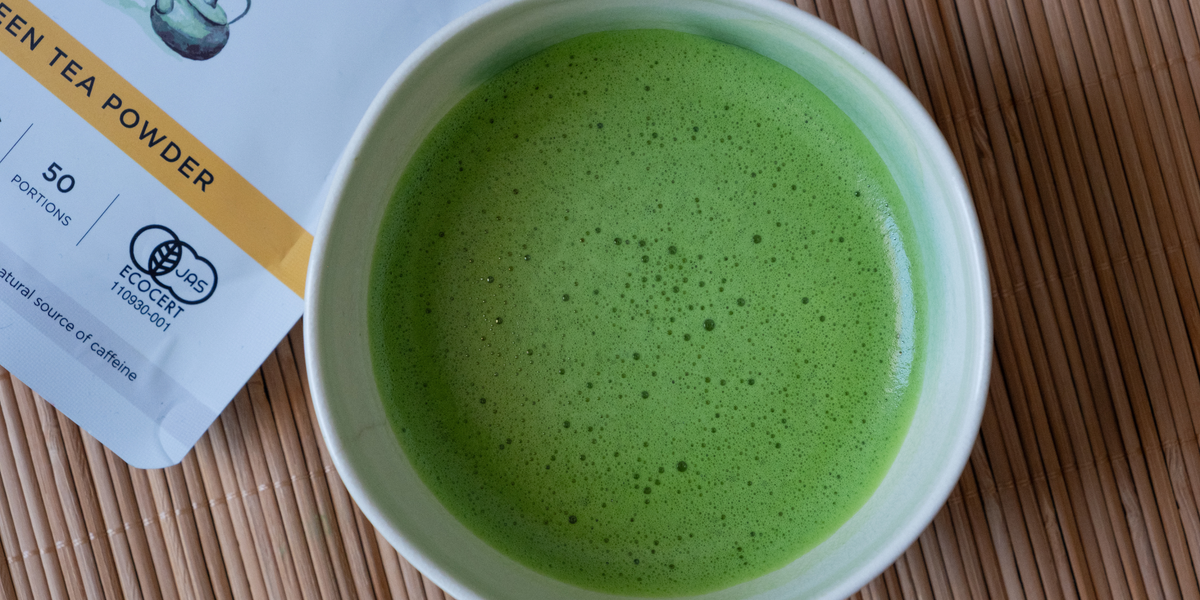
- Proper storage preserves freshness, color, aroma, and texture.
How to Check If Your Matcha Is Good Quality
- Color. It should be a vivid, saturated green, not dull, olive, or yellowish.
- Aroma. Fresh, grassy, faintly sweet. Musty or flat means it's aged past its best.
- Texture. Fine and almost silky when sifted, not gritty or clumped.
-
Taste, before adding anything. Smooth and balanced on its own in water, not sharp or one-dimensional.
What Usually Goes Wrong in Preparation
Too much powder tastes intense and bitter. Too little tastes thin and watery.
Skipping the paste stage, adding matcha straight into water instead of whisking it into a paste first, leaves clumps that taste sharp and gritty.
Using culinary-grade matcha as a drink, instead of ceremonial or barista grade, gives a flatter, more bitter cup regardless of technique.
|
Mistake |
Result |
|
Water too hot |
Sharp, sweetness barely present |
|
Too much powder |
Intense, bitter |
|
Too little powder |
Thin, watery |
|
Skipped the paste |
Lumps, uneven taste |
|
Wrong grade |
Flatter, more bitter |
|
Stored in glass or heat |
Dull color, flat, bitter, regardless of original quality |
How to Brew It Right
- Soak the bamboo whisk in hot water to soften the prongs.
- Sift 2 g of matcha into the bowl.
- Add 20 ml of warm water (70°C) and whisk into a smooth paste.
- Pour in the remaining water (40 ml).
- Whisk in a W-motion until a fine foam forms.
- Drink immediately, on its own or with milk.

One bad cup says more about that day's matcha, water, and technique than about matcha as a category. Change even one variable, the storage, the temperature, the ratio, and the same starting point often tastes completely different.
Matcha rewards consistency more than most drinks. The same bag, prepared the same way, should taste the same every time.
Start with a ceremonial grade matcha, made for drinking.
Sources:
Ahmad, F. et al. (2026). Synergistic enhancement of matcha tea with strawberry (Qassim region) aqueous extracts: influence of extraction temperature on phytochemicals, vitamin C, and bioactivities. Frontiers in Nutrition: https://pubmed.ncbi.nlm.nih.gov/42199755/